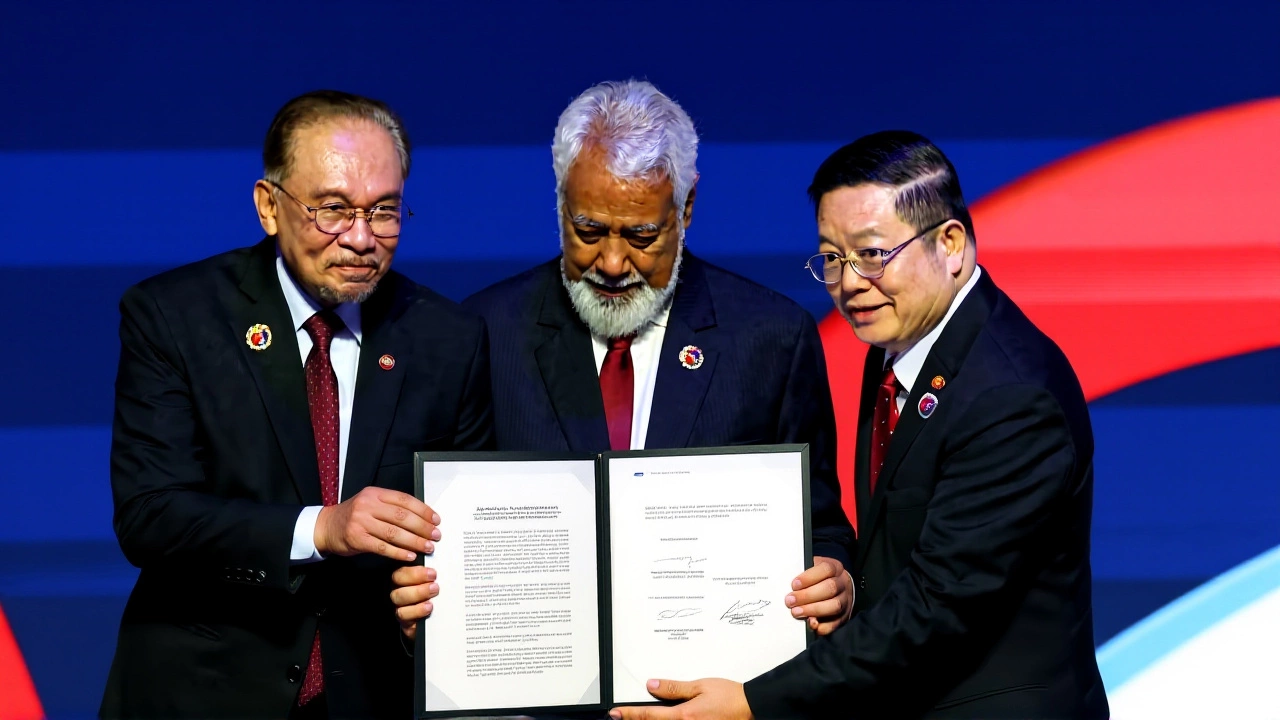
At 9:25 AM UTC on October 26, 2025, history was written in Kuala Lumpur. Kuala Lumpur, the capital of Malaysia, hosted the formal admission of Timor-Leste as the 11th member of the Association of Southeast Asian Nations (ASEAN). The moment — quiet but monumental — came during the 47th ASEAN Summit, a three-day gathering that began on October 25. For 14 years, Timor-Leste had waited. For 26 years, ASEAN had stayed the same size. Now, the bloc has grown again. And the implications? They ripple far beyond the summit hall.
A 14-Year Wait, Finally Over
The journey began in 2011, when Timor-Leste, a nation barely two decades removed from its hard-won independence, first applied for observer status. Back then, ASEAN was cautious. The bloc, founded in 1967 with just five members, had prided itself on consensus — and non-interference. Timor-Leste’s small size, fragile institutions, and complex history with Indonesia made some members nervous. But the country pressed on. Diplomats from Dili made regular trips to Jakarta, Bangkok, and Singapore. They attended every ASEAN meeting as observers, even when no one was watching. By 2019, they were granted candidate status. The final push came in early 2025, when Malaysia, as the rotating chair, made Timor-Leste’s admission a personal priority. "It wasn’t about politics," one senior ASEAN official told a regional newspaper in September. "It was about geography. About justice. About giving the last missing piece a seat at the table."The Ceremony That Changed the Map
The admission ceremony unfolded at the Kuala Lumpur Convention Centre. Delegates from all ten existing members stood as Timor-Leste’s Prime Minister, Taur Matan Ruak, walked to the podium. No speeches were long. No fireworks. Just a signed document, a round of applause, and the raising of Timor-Leste’s flag beside the others — for the first time. The YouTube video of the moment, uploaded the same day, shows a moment of quiet dignity. No one cheered wildly. But many wiped their eyes. The bloc’s population jumped from 640 million to roughly 675 million overnight. Economically, Timor-Leste adds little — its GDP is smaller than Singapore’s. But symbolically? It’s everything.Timor-Leste is now the first new member since Cambodia joined in 1999. That 26-year gap between expansions was the longest in ASEAN’s history. And it wasn’t for lack of trying. Papua New Guinea applied in the 2000s. East Timor’s own application had been stalled for years. The reason? ASEAN’s rules require unanimous consent. And for a decade, at least one member — often Indonesia — hesitated. Indonesia, which once occupied Timor-Leste, had deep reservations. But by 2024, Jakarta had shifted. "We can’t ignore our neighbor’s future," said Indonesia’s Foreign Minister in a rare public statement. "We are all in this region together."
What This Means for Southeast Asia
The Diplomat called the admission a "new challenge" — and they’re right. Timor-Leste is poor. Its infrastructure is underdeveloped. Its bureaucracy is thin. It lacks the resources to fully participate in ASEAN’s complex trade agreements, security dialogues, or climate initiatives. That means the existing members will have to invest more — in training, in funding, in patience. The bloc’s secretariat in Jakarta will need to expand its capacity. New working groups will form to help Timor-Leste meet ASEAN standards on everything from fisheries to intellectual property. But here’s the twist: Timor-Leste brings something the others don’t. A fresh moral authority. After decades of occupation, violence, and international neglect, its presence reminds ASEAN of its original promise — to lift up the region’s most vulnerable. It’s not just about economics. It’s about identity.
What Comes Next?
No formal transition plan was announced. But insiders say Timor-Leste will be granted a five-year grace period to adapt to ASEAN norms. During that time, it won’t be required to sign every treaty. But it will be expected to attend every meeting. The next major test? The ASEAN Economic Community’s 2030 goals. Can Timor-Leste, a country with only 1.3 million people, contribute meaningfully? Probably not in volume. But perhaps in voice. And that may be more valuable than any trade deal.The Bigger Picture: Why This Matters
ASEAN has often been criticized as a talk shop. But this moment proves it can still act — decisively, compassionately. In a world where borders are hardening and alliances are fracturing, ASEAN chose inclusion. It chose history over inertia. And in doing so, it sent a message to the world: even the smallest nations deserve a seat. Timor-Leste’s flag now flies in Jakarta. Its diplomats will sit beside those from Thailand, Vietnam, and the Philippines. It’s a small change on the map. But for a people who survived genocide and occupation, it’s everything.Frequently Asked Questions
Why did it take Timor-Leste 14 years to join ASEAN?
Timor-Leste’s path was slowed by ASEAN’s requirement for unanimous consent and lingering political sensitivities, especially from Indonesia, which had occupied East Timor from 1975 to 1999. Many members doubted its capacity to meet economic and governance standards. It wasn’t until 2024, after years of diplomatic outreach and internal reforms, that all members agreed to move forward.
How does Timor-Leste’s membership affect ASEAN’s economic goals?
Timor-Leste’s economy is tiny — GDP around $1.8 billion — and it lacks the infrastructure to fully integrate into ASEAN’s trade networks. But its inclusion doesn’t weaken ASEAN’s goals; it tests them. Existing members will need to provide technical aid and capacity-building support, turning ASEAN into a more developmental bloc rather than just a market alliance.
Is Timor-Leste the first new member since 1999?
Yes. Cambodia joined ASEAN in 1999, making Timor-Leste’s admission in 2025 the first expansion in 26 years. This long gap highlights ASEAN’s traditionally cautious approach to membership. No other country has been formally admitted since then, despite applications from Papua New Guinea and others.
What challenges will Timor-Leste face as a new ASEAN member?
Timor-Leste struggles with weak institutions, limited bureaucracy, and underdeveloped infrastructure. It must now comply with ASEAN’s standards on trade, environment, labor, and security — areas where it currently lacks capacity. The bloc has promised a five-year transition period, but the real challenge will be sustaining political will and funding from wealthier members.
Why did Malaysia push so hard for Timor-Leste’s admission?
As the 2025 ASEAN chair, Malaysia saw Timor-Leste’s admission as a legacy issue. Prime Minister Anwar Ibrahim framed it as a moral imperative — a chance to correct historical imbalances and reinforce ASEAN’s identity as a regional community, not just an economic club. Malaysia also hoped to strengthen its leadership role in Southeast Asia.
What does this mean for other aspiring members like Papua New Guinea?
Timor-Leste’s admission sets a precedent: persistence pays. Papua New Guinea, which applied in 2009, now has a clearer path. But it also raises the bar. ASEAN will likely demand stronger governance reforms before considering new members. The bloc is signaling that inclusion is possible — but not automatic.

Write a comment